
"The Champion Who Wasn't Supposed to Make It"
Aug 14, 2026Ian Renshaw & Keith Davids review Gullich et al (2021) — "What Makes a Champion: Early Multidisciplinary Practice, Not Early Specialization, Predicts World-Class Performance"
Paper Under Review — What Makes a Champion: Early Multidisciplinary Practice, Not Early Specialization, Predicts World-Class Performance. Gullich, A., McNamara, B. N., & Hambrick, D. Z. (2021). Perspectives on Psychological Science. Meta-analysis of 51 studies, ~6,000 athletes, 15 countries.
There's a player in almost every talent development system who coaches remember. Not because they made it — but because they should have. The one who trained the hardest at 14, looked the part at 16, and then quietly disappeared. And there's another player, somewhere nearby, who nobody expected. The one who played three sports, took winters off, drove their coach slightly mad. Who made it, somehow, when the data said they shouldn't.
Gullich, McNamara, and Hambrick decided to look at which of those two players shows up more often at the top. Their 2021 meta-analysis — 51 studies, roughly 6,000 athletes, 15 countries — came back with a clear answer. It's the second one.
The Paper and What It Found
The study was testing the long-running debate in expertise research: early specialisation versus early diversification. Does focusing early on one sport with high volumes of deliberate practice produce world-class performers? Or does a varied, multi-sport childhood — with later specialisation — better predict who reaches the top?
The data landed firmly on the side of diversification. World-class athletes had specialised *later* than national-level athletes. They had spent *more* time in coached practice across other sports during childhood and adolescence. And they had accumulated *less* total practice time in their main sport across their careers. More notably still: the successful junior athletes — the ones peaking early — were the least likely to become world-class seniors.
That last finding is the one that deserves the most attention from coaches, academies, and parents.
What the Numbers Miss
Keith's first point in this episode is to take the findings seriously — and then ask what they can't tell us.
A meta-analysis is only as good as the research it pulls from. This one drew exclusively on published empirical studies, which means it systematically excluded the experiential knowledge of athletes and coaches. The backyard cricket, the beach football, the New York playground basketball that produced so many elite careers — none of it fits the inclusion criteria of a peer-reviewed study. So it simply doesn't exist in the dataset.
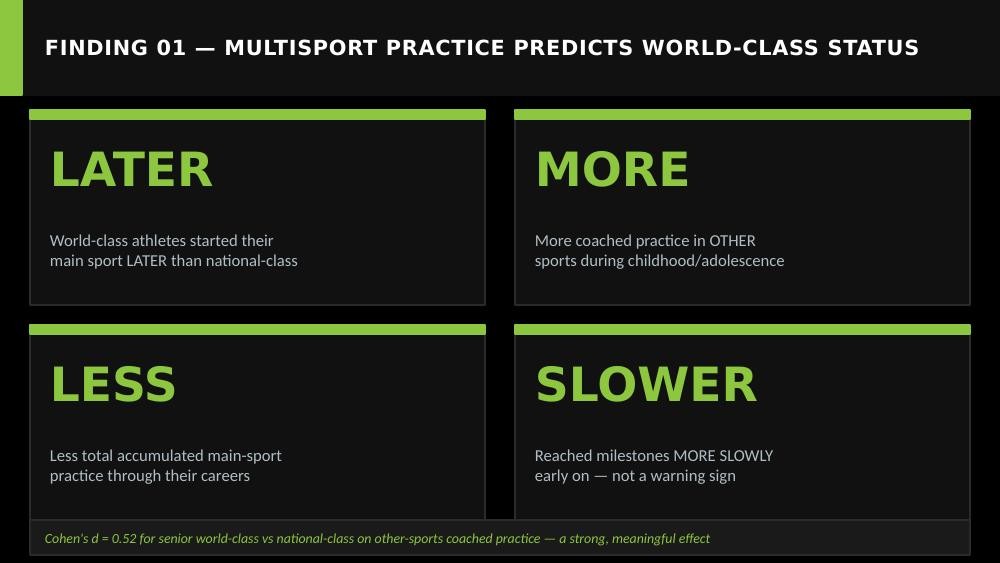
"Finding 01 — multisport practice predicts world-class status, adapted from Gullich, McNamara & Hambrick (2021)."
The paper also found no significant effect for "deliberate play" — Jean Cote's model of child-led unstructured activity. Keith's interpretation: this almost certainly reflects who gets studied (athletes enrolled in formal programmes) rather than what actually develops champions. The Pacific Islands have been producing world-class rugby players for decades. Brazilian futsal shaped Ronaldo, Ronaldinho, and hundreds of others who never appeared in a Western talent development dataset. One of the founders of the Athletic Skills Model, Rene Wormhoudt — still, as of the 2026 World Cup, coaching the Dutch national squad — has spent thirty years arguing for the developmental power of children organising their own games. None of that makes it into a meta-analysis.
The volume numbers have the same problem. Hambrick and McNamara's own re-analysis of Ericsson's deliberate practice database found that some chess players needed 3,000 hours to reach master level. Others needed 23,000. When the variance in a dataset is that large, the average tells you almost nothing. Keith put it simply:
"It's not how much practice — it's what you do in practice that's far more important."
This is the same argument Keith made over two decades ago in Davids, K. (2000). "Skill acquisition and the theory of deliberate practice: it ain't what you do, it's the way that you do it!" International Journal of Sport Psychology, 31, 461–465.
The Junior Who Just Wanted a Day Off
Ian told a story that highlights the dangers of treating adolescents as high performance athletes and exposing them to adult training programmes.
He was coaching an under-17 cricket team. He had a player he thought had real potential — probably more than the kid himself realised — and asked him if he would be keen to play grade cricket on Saturdays. Ian asked him about his ambitions.
"Play for the school first XI," the boy said.
Ian gently questioned him more. Surely there's more there? The boy's response:
"Ian, I just want a day off. Monday morning I'm doing fielding and gym. Tuesday, batting. Wednesday, Thursday, Friday — training every night. I play on Sunday. I just want one day to go surfing with my mates."
**[Image — insert here via the toolbar's image button]**
Upload `Blog/Images/clip_burnout_dayoff.jpg` (still frame from the video of Ian recounting this story). Alt text: Ian Renshaw recounting the U17 player's "I just want a day off" story. Caption if supported: "Watch: Ian recounts the U17 player's 'I just want a day off' moment in full — full clip in the members area."
This isn't a young player without ambition. This is a teenager being run into the ground — six sessions a week at 17, training like a professional adult, with nobody asking what he actually needed. Keith connected it to the developmental biology: adolescence is a period where psychological, physical, social, and hormonal systems are all changing at different rates simultaneously. Push too hard in one direction and you create instability across all of them.
The junior-senior paradox isn't a statistical quirk. It's what happens when you ignore this.
The False Binary
One thing Ian and Keith are careful to resist is the temptation to replace one oversimplification with another. The paper doesn't prove that early specialisation is always wrong, any more than Ericsson proved that 10,000 hours is always right.
Tiger Woods is the canonical example of early specialisation. But Ian's description of his childhood practice sounds nothing like drilling. It was invented games, trick shots, progressively adjusted challenges — ecological and playful from the start. His father didn't prescribe a training volume. He created an environment. Keith used Djokovic as a counter-example: the skiing he did as a child gave him a sliding movement vocabulary that changed how tennis players move on court. Neither man was running a programme that would fit neatly into either camp of the debate.
The question worth asking, Keith argued, isn't "which pathway wins?" It's "what does "this individual" need, at "this stage", to keep developing?" The Athletic Skills Model captures it in its logo: first the child, then the athlete. Development coaching, in Keith's framing, is as important as preparation for elite competition — and a lot harder.
In a similar vein Ian's latest book written by Motivational Interviewing founder, Stephen Rollnick, Dynamic Coaching: A Playbook for Cricket Coaches, Ian cites Andy Flower — who took England to number one in the world rankings, won the Ashes in Australia (one of cricket's rarest achievements), and is currently winning IPL titles with Royal Challengers Bangalore — said he would put the player first before the cricketer if he had his time again. It's the same thing.
"If I had my time again, I'd put the player first before the cricketer." — Andy Flower, England Head Coach & IPL winner (Royal Challengers Bangalore), quoted by Ian Renshaw
Adaptability as the New Standard
The conversation ends somewhere unexpected. Keith and Ian connect early developmental diversity not just to talent production but to what elite performance increasingly demands. The soccer goalkeeper who was trained on long clearances a decade ago is now struggling because the modern game requires them to play out from the back with short passes. The NBA analytics movement has exposed specialists — players whose narrow skill set can be neutralised through targeted matchups.
The athlete who played multiple sports, who had to read unfamiliar environments, solve problems they hadn't seen before, coordinate with teammates whose habits weren't predictable — that athlete carries something into the elite environment that no amount of position-specific drilling can produce: the ability to adapt.
"In the end, if you're adaptable, you've got more chance of getting picked. Make them be able to go in and play different roles and solve different problems." — Ian Renshaw
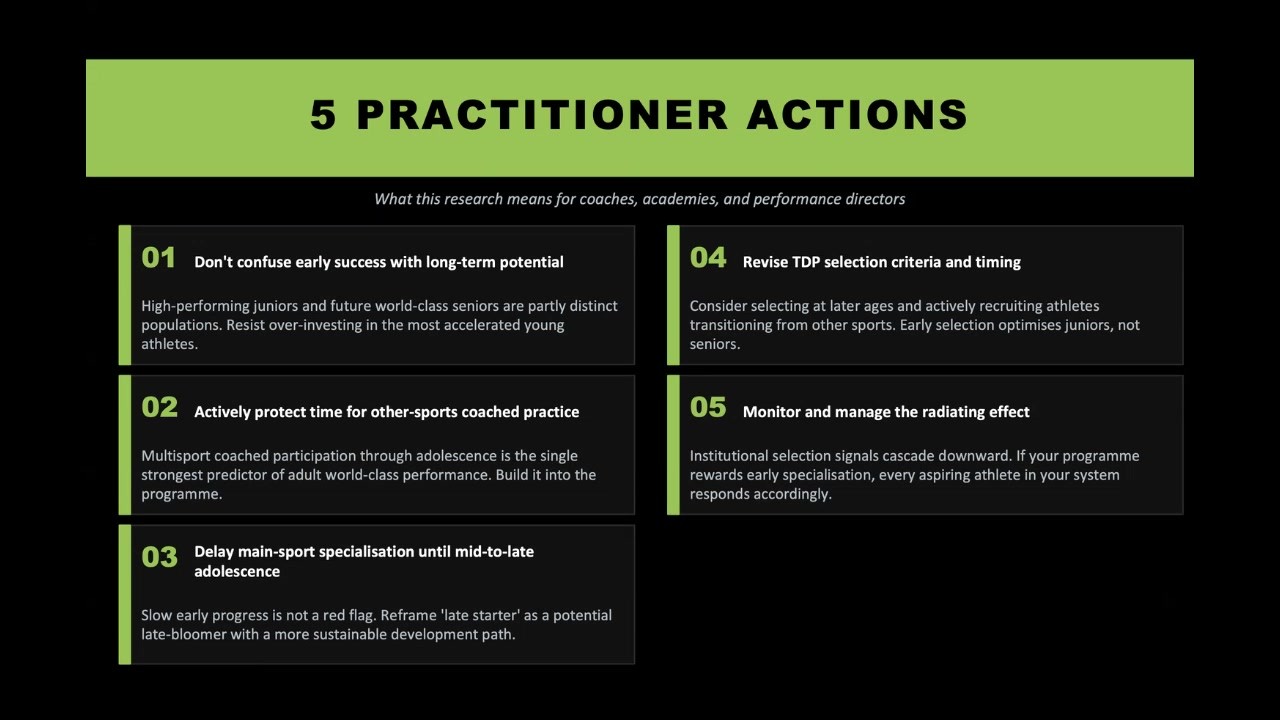
Watch: Ian and Keith on why adaptability, not specialisation, is what elite selection increasingly rewards — full clip in the members area."
That's the coaching challenge Gullich et al point toward, even if their data can only gesture at the mechanisms. Not early specialisation. Not late specialisation. The kind of varied, challenging, playful early experience that produces athletes who are ready for a game that will ask things of them nobody has anticipated yet.
This episode is available now on Buzzsprout and all major podcast platforms. Listen at buzzsprout.com/2354827 (link to: https://www.buzzsprout.com/2354827)
— Ian Renshaw, Keith Davids & Martyn Rothwell, The Constraints Collective