
Episode 100 · Prof. Chris Button (Part One) · The Constraints Collective Podcast
Aug 06, 2026The Funnel, Not the Average: Chris Button on the PhD That Almost Wasn't (Part One)
Episode 100 · Prof. Chris Button (Part One) · The Constraints Collective Podcast
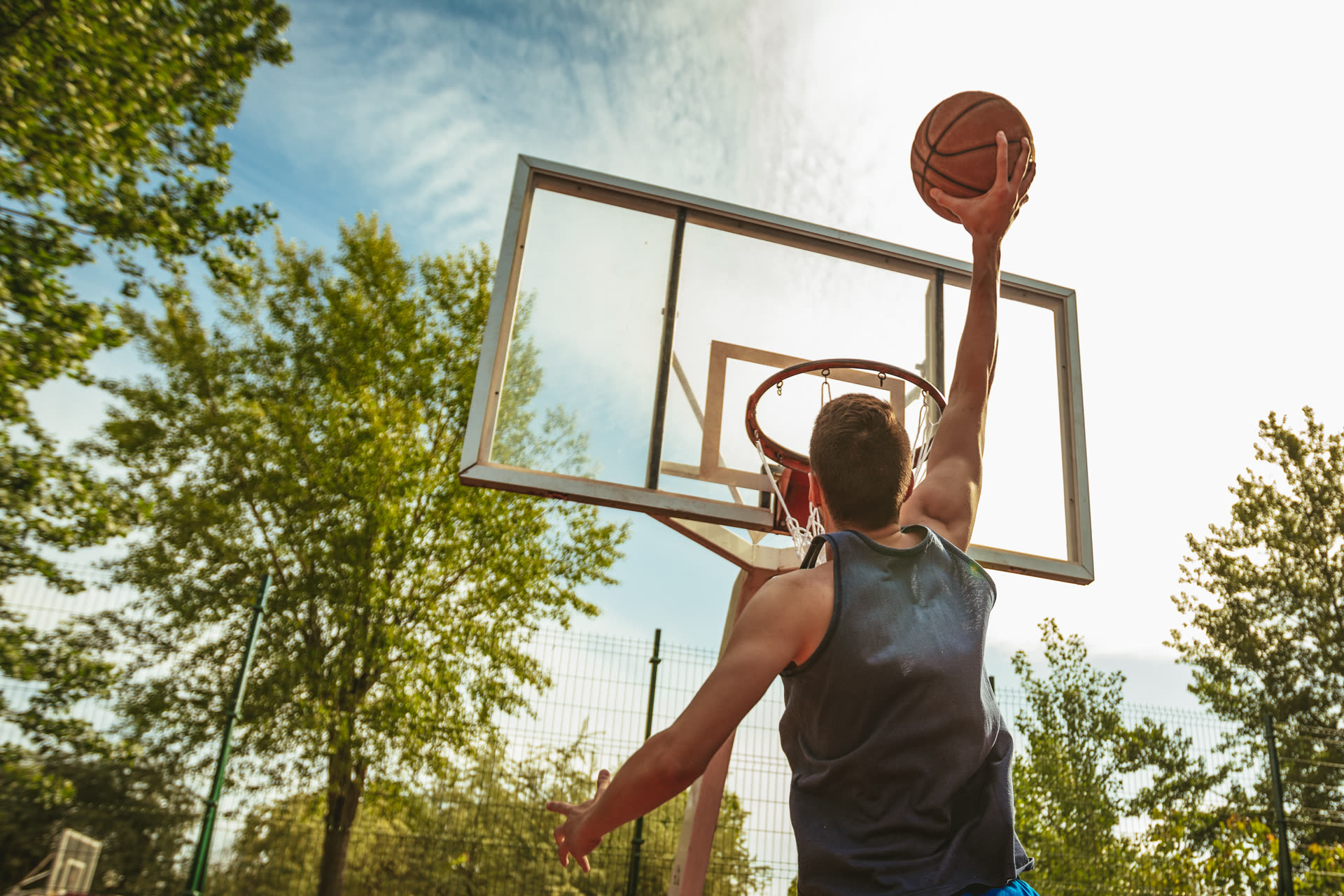
Hand someone a hammer, a nail, and a piece of wood. Ask them to hit the nail ten times, filmed side-on. The start of each swing is never quite the same place twice. But as the hammerer locks onto the task goal — hit the nail — the swing narrows through online perception-action coupling, correcting itself in real time as the hammer closes in on the nail. Now ask them to do it with the other hand. They don't repeat a smaller version of the same funnel. They simplify the task altogether: a shorter swing, less power, fewer moving parts to control. Bernstein called this freezing the degrees of freedom — the strategy a system falls back on when a task gets harder to control.
That demonstration — Ian Renshaw's classroom version of a research idea — traces straight back to Chris Button, guest for The Constraints Collective's 100th episode. Chris is a Professor at the University of Otago, director of research that has ranged from ball-catching biomechanics to basketball free throws to, now, why so many people drown. Before any of that arrives, though, this conversation is about the PhD that almost didn't happen, and the finding buried inside it that coaches still routinely average away.
The Passport, Not the Job Offer
Chris's route into research wasn't inevitable. Fresh out of an undergraduate cohort at Manchester Metropolitan University that Keith still calls a "superstar" group, Chris turned down a PhD scholarship to take a job as a wine specialist. Keith rang, offered the PhD, got a no, and had all but given up on him.
A few days later, Chris rang back.
"It was your PhD is your passport anywhere," Chris says, recalling the line Keith had left him with. "And of course, you couldn't have said a truer word."
It's a small anecdote, but it sets up the episode's real argument: Chris didn't arrive already converted to ecological dynamics. He was talked into a fork in the road by one sentence, and the value of everything that followed rests on that single reversal.
The ANOVA That Showed Nothing
The PhD itself — coordination in ball-catching, supervised by Keith and Simon Bennett — ran into a problem early. Chris had a small group of participants, and he could see, watching them collect data in real time, that they moved differently from one another. Then he ran the standard group-level statistics.
"I really delved into that data because… the ANOVA was showing nothing," Chris says. "It was showing no differences. And I was confused because I'd seen that there were differences between them as I was collecting the data."
The fix wasn't better instrumentation. It was refusing to average. Some participants shifted one way, some the other, some barely changed at all — and pooling them into a single group mean erased all three patterns at once. Chris's response was to analyse individuals as individuals, a move that drew early pushback (small samples, no statistical power) before Human Movement Science and the wider field caught up.
A Free Throw Is Never the Same Free Throw
Years later at Edinburgh, working with an honours student on basketball, Chris ran the same logic on a much more familiar skill: the free throw. Coaches assume a shot this repetitive is close to a fixed motor programme — same joints, same angles, every time, "a little bit like darts."
"It's just so locked in, you know, a little bit like darts — it's got to be the same movement," Chris says. "But it wasn't. It clearly wasn't."
Novices showed wide variability early in the action; experts showed a funnel — real variability at the start of the shot, narrowing as the ball approached release, with small compensations in the wrist and fingers taking up the slack. The skill wasn't the absence of variability. It was the timing of when variability was allowed to matter.
Interdisciplinary by Accident, Not by Design
The MMU course Chris came through was structurally unusual for its time. While most sport science courses stayed inside their own silo (physiology here, biomechanics there), Chris's lecturers pushed students to hold a more inter-disciplinary approach. Students were also encouraged to go deeper in their thinking. For example, in an advanced motor control and learning module, Keith promoted a debate around the different theoretical models that underpinned skill acquisition and asked the cohort to argue between them in a formally assessed debate.
That thinking followed Chris to Otago, where a role explicitly designed to bridge disciplines — directing a Human Performance Centre rather than a single lab — turned out to matter more than he expected at the time. He didn't choose it because he had a plan. He chose it because his course had led him to see problems through inter-disciplinarity.
At that point in time, Chris had no idea how this mindset was going to lead him throughout his career.
"At that time," he says, "no idea that water safety or doing anything in that kind of realm was coming in the future for me."
The nail funnels the same way as the free throw does: variability is not noise, but the way a skilled performer solves the problem. Chris's PhD found that pattern in a hand closing around a ball. Two decades of interdisciplinary habit later, he'd find a version of the same question in open water — which is where Part Two picks up.
Part One of Two — Part Two continues in August's Week One Guest Podcast. Listen to Episode 100 of The Constraints Collective Podcast on Buzzsprout, Spotify, Apple Podcasts, and all major platforms.
(Link "Buzzsprout" to: https://www.buzzsprout.com/2354827)